What Compatibility Means When Two People Define It Differently
Understand relationship compatibility by clarifying what each person means, comparing everyday expectations and deciding which differences feel workable.

Across a café table, one person says they want a compatible partner; the other asks, “What does that mean to you?” Relationship compatibility can mean feeling at ease, sharing a way of life or handling disagreements with care. A useful answer describes what each person hopes the relationship will feel like, rather than delivering a verdict on the match.
Relationship compatibility depends on what needs to fit
Compatibility describes how well two people’s needs, habits and expectations can fit together in the relationship they want to build. It is not a single quality that either exists or does not. Two people might communicate easily but differ on how much time they want together; another pair might share routines yet need to work harder to understand one another.
The word often bundles several questions: Do we enjoy each other’s company? Can we discuss awkward subjects? Are our expectations for commitment, family life or everyday routines workable together? Naming the dimension makes the conversation more useful than saying simply, “We’re compatible” or “We’re not.”
A good fit does not require identical tastes or personalities. It asks whether each person can live with the differences that matter and treat those differences with care. Like two chairs at the same table, people need not be made alike; they do need to leave each other room.
The same word can carry different expectations
People bring their own histories and hopes to a familiar label. One person may use “compatible” to mean that conversation flows without effort. Another may mean that both people want a committed relationship and agree about what commitment involves.
The same word can also hide different standards. “Good communication” might mean speaking openly as soon as something feels wrong to one person, while another needs time to think before talking. Neither meaning is automatically unreasonable. But if each assumes the other shares their definition, an ordinary difference can feel like a broken promise.
Instead of asking only, “Are we compatible?”, try, “When you say compatible, what would you hope we could do together?” or “Which part of a relationship matters most to you?” Those questions invite an answer about lived experience rather than a polished slogan.
Ask about ordinary situations rather than scoring a match
Keep the conversation curious and specific. Ask about a situation, listen to the answer, then offer your own view without presenting it as the correct definition. You are comparing expectations, not scoring someone’s performance.
Imagine you are getting to know someone who calls reliability essential. You ask what reliability looks like in an ordinary week. They say they value keeping plans and saying promptly when plans change; you explain that you can be dependable but sometimes need quiet time before replying to a difficult message. The observable result is a clearer conversation about plans and response expectations, not an instant ruling on the match.
A useful follow-up is, “What would feel difficult for you?” It makes room for limits as well as wishes. If an answer surprises you, check that you understood it before deciding what it means for the two of you.
Discuss the dimensions that matter to you
There is no universal set of dimensions that matters equally to everyone. Use these prompts to start a conversation, not as boxes to tick or a hidden scoring system:
- Communication: Ask how each of you prefers to raise concerns and whether you need time to think first. If one approach feels manageable to both, continue; if it leaves someone feeling rushed or shut out, agree on another way to begin difficult conversations.
- Emotional connection: Ask what helps each person feel understood and how they tend to offer support. If your ways of offering care feel welcome, keep learning each other’s cues; if not, describe what would feel more supportive.
- Everyday rhythm: Compare preferences for time together, time apart and advance planning. If those preferences can coexist, discuss a routine; if they clash, talk about which adjustment each person can genuinely accept.
- Commitment: Ask what kind of relationship each person seeks and what commitment means in practice. If the intentions align, discuss what they look like day to day; if they do not, be honest about whether either person wants the same relationship.
- Future expectations: Discuss hopes about family, home or work that you would want a partner to understand. If both people can make room for the other’s hopes, keep exploring; if a major hope conflicts, clarify whether it is flexible before making plans around it.
- Difference and repair: Ask what happens when you disagree and what helps you reconnect afterwards. If both can describe a respectful way forward, use it when tensions arise; if one person dismisses or pressures the other, pause and address that pattern rather than brushing it aside.
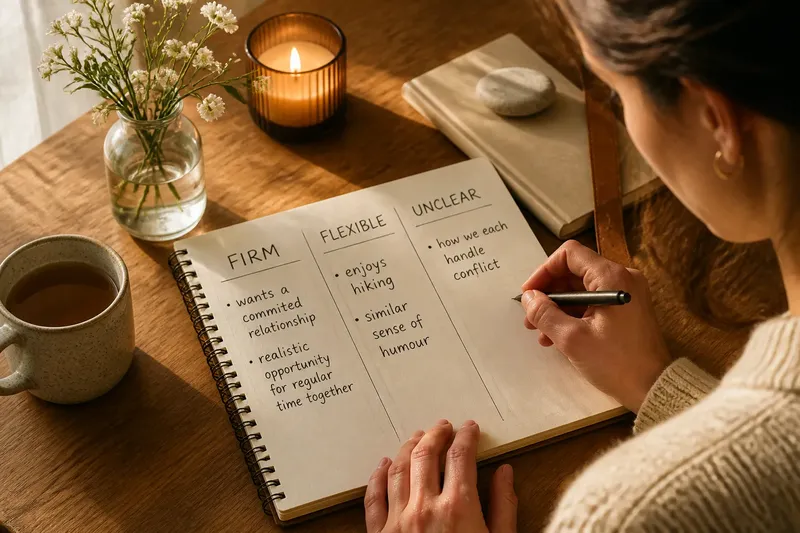
The point is not to settle every subject in one sitting. Notice which topics bring clarity and which need more conversation. Someone may be flexible about routines but firm about relationship intentions; knowing that distinction is more useful than hearing a broad claim that you “want the same things.”
Separate a difference in wording from a difference in need
If one person says “space” and means an evening alone now and then, while the other hears withdrawal from the relationship, ask for a concrete description. You may discover that the underlying expectation is closer than the label suggested.
If the needs really differ, ask whether there is an arrangement both people can accept. That does not mean bargaining away something essential to you. It means understanding the practical effect of the difference and deciding honestly whether the relationship you each want can accommodate it.
Say you are dating someone who wants more time together than you do. You explain that you enjoy seeing them but also need quiet evenings alone; they say they want regular plans but do not need every evening together. You agree to discuss plans in advance and leave some evenings open. The observable result is that each person can judge whether the arrangement feels comfortable in practice; if one still feels pressured or neglected, you have clearer information about the mismatch.
Compatibility can become clearer over time. A person’s answer to an abstract question may be less revealing than how you both handle a changed plan, a vulnerable conversation or a difference of opinion. Treat those moments as information, not as a single pass-or-fail test. If a pattern repeatedly leaves one person feeling unheard or pressured, take it seriously rather than relying on a hopeful label.
What questions clarify relationship compatibility?
Can people with opposite personalities be compatible?
Yes, when their differences are understood and manageable for both people. A lively social organiser and someone who prefers quieter evenings may find a workable rhythm if neither expects the other to change their temperament.
Does compatibility mean having the same interests?
No. Shared interests can give people pleasant ways to spend time, but they do not establish that expectations or communication styles fit. Curiosity about each other matters more than matching every hobby.
Can relationship compatibility change over time?
What feels workable can shift as circumstances and priorities change. Talking about those changes helps each person understand whether the relationship still fits their needs.
How can I tell whether a difference is workable?
Ask what the difference means in daily life and whether both people can discuss it without pressure or dismissal. It is more likely to be workable when each person can describe their needs honestly and consider the other’s.
Use compatibility to describe a specific fit
When you use “compatibility,” attach it to the dimension you mean. Say, “I value a relationship where we can talk through tension,” rather than treating compatibility as a mysterious quality someone either has or lacks. Then ask how the other person sees that dimension and what it looks like in ordinary life.
This precision makes relationship compatibility easier to discuss and harder to mistake for a promise of effortless agreement. The next time you wonder whether you fit, begin with the meaning each of you gives the word. A clearer answer can show where you align, what you can accept and what still needs an honest conversation.