Before the Profile Card: How Matchmaking Framed a Good Pairing
Explore how matchmaking descriptions changed from local introductions to personal profiles, and learn to read each format with clearer expectations.
A relative introduces two people after Sunday lunch, then quietly explains what each one should know about the other. That small scene captures an old question in matchmaking: who gets to tell the story before a first meeting? The history of matchmaking descriptions is not a single march towards personal choice. Different communities and services have used different ways to arrange introductions, and older customs continue alongside newer ones.
Matchmaking descriptions reflected local expectations
In some communities, families and intermediaries helped arrange introductions by considering shared faith, kinship, work, reputation or practical household concerns. Those factors could matter because a marriage might affect relatives and social ties as well as the couple. The particular priorities varied, so it is safer to think of these arrangements as diverse practices rather than one universal system.
A description from a relative or community matchmaker often carried local context. Someone might be known as dependable because neighbours had seen them keep a promise, or as a good fit because their family already had ties to the other household. That background could make an introduction feel more informed. It could also leave the person being introduced with little say over which qualities were emphasised.
The intermediary acted a bit like a label on a parcel: useful for directing it, but unable to show everything inside. A favourable account might open a door, yet it could not tell two people how they would talk together or handle a difference of opinion.
Printed notices widened the audience but narrowed the portrait
Personal notices and other forms of print have been used in some places to seek introductions or marriage partners. Their history differs by country, publication and period, so a simple timeline would hide important variation. The practical point is clearer: a written notice could reach readers beyond a person’s immediate circle, while its limited space encouraged brief, recognisable descriptions.
Such notices might mention occupation, background, character or the kind of partner sought. Those details helped a reader decide whether to make contact, but they could not convey the texture of daily life. Qualities that were easy to put into words could take up more space than habits, humour or a person’s particular hopes.
Print also changed who interpreted the description. Strangers could read it without knowing the person or their family. The writer gained a route to a wider audience, but readers had to make sense of a compact portrait with little shared context.
Personal advertisements let seekers speak in the first person
Personal advertisements offered people a way to describe what they wanted and what they hoped to bring to a relationship. The first-person voice could be a meaningful change from relying entirely on someone else’s account. Still, writers chose their words for an audience, and local expectations could influence what felt appropriate to disclose.
Someone might state a wish for companionship in formal language, or describe a hoped-for partner through qualities others readily recognised. Speaking for oneself did not remove social pressures; it changed the balance of the conversation. The writer controlled more of the initial wording, while readers remained free to interpret it in their own ways.
Dating services turned introductions into a managed process
Some matchmaking agencies and dating services use forms or interviews to gather information before suggesting introductions. The questions can make practical preferences easier to discuss, but a form also decides which answers fit neatly into boxes. A person may be able to state a commitment or interest more easily than explain how it shapes an ordinary week.
The service can influence the process by deciding what to ask, what information to pass on and which introductions to propose. That is not the same as the service knowing what will make a relationship work. It is a reminder to ask how an introduction was selected and whether the account being shared sounds like the person who gave it.
Profiles make the opening account more personal
A dating profile allows its author to choose words, photographs and prompts directly. That can make a first impression feel more individual than a bare list of formal details. The format still has limits: short prompts favour details that can be expressed quickly, and a profile cannot show every part of someone’s life.
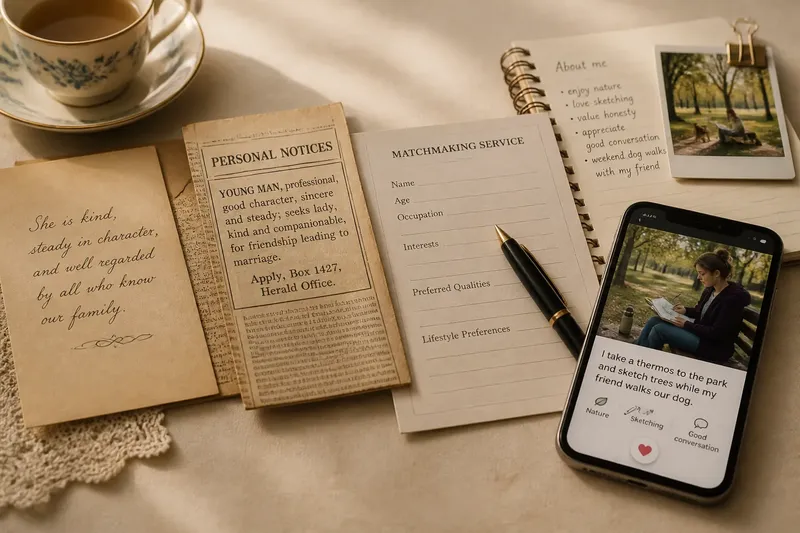
Imagine that Maya is writing a profile and first types, “I’m easy-going and fun.” She replaces it with a specific detail: she takes a thermos to a local park and sketches trees while her friend walks a dog. The observable change is that a reader now has something concrete to ask about, such as what she likes to draw. The detail does not predict whether they will suit one another; it simply gives the conversation a more personal opening.
When reading a profile, treat it as one person’s chosen introduction, not a complete account. Notice what is specific, what remains unclear and what you would like to ask. A broad label may be sincere but mean different things to different readers, while a small everyday detail can prompt a useful follow-up.
How should you read a matchmaking description?
What did a matchmaker contribute to an introduction?
A matchmaker could bring local knowledge, family context or a reason for suggesting two people meet. The account still reflects that intermediary’s perspective, so it helps to hear directly from the people involved.
Did printed notices work the same way everywhere?
No single account covers every place or period. Publications and customs differed, so a particular notice is best understood within its own setting rather than treated as representative of all matchmaking.
What can a dating profile tell you?
It can show what a person has chosen to share and offer prompts for a first conversation. It cannot settle questions about character or compatibility, which become clearer through respectful, direct interaction.
How can you ask about a vague description?
Choose one phrase and ask what it looks like in everyday life. If someone describes themselves as adventurous, for example, you might ask what kind of recent outing they enjoyed; their answer gives context without turning the exchange into an interview.
Keep the source of each description in view
A family introduction, a printed notice, an agency profile and a dating-app bio each have a different author and audience. Before drawing a conclusion, ask who selected the details, what the format leaves out and whether the person can explain their own account. That simple habit makes it easier to treat an introduction as a starting point rather than a verdict.
The search phrase “history of matchmaking descriptions” points to more than changing forms of communication. It also raises a practical question for anyone meeting someone new: whose words are you reading, and what would you rather learn from the person directly?